75.1
42.1
46.6
61.2
64.4
66.5
69.8
U2-RadiMed

Claude-5 Sonnet

Med-Gemma

Hulu-Med

GPT-5.5

Qwen3.8-Max

GPT-5.6-Sol
U2-RadiMed
Lesion detect, Dx aid & report gen for imaging
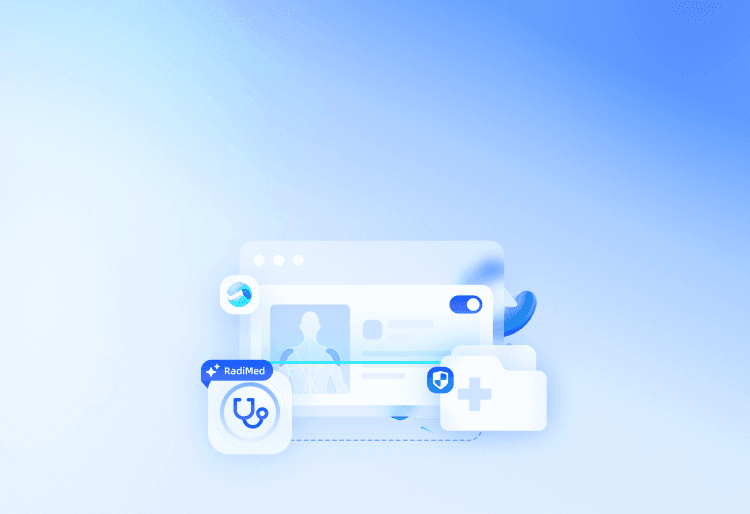
U2-RadiMed is Unisound’s medical imaging LLM for image+text input. It helps doctors read scans, locate lesions, aid Dx, and auto-generate structured reports — an end-to-end AI assistant from image analysis to clinical decision support.
This evaluation covers the full capability stack from low-level perception (lesion detection and localization) to high-level reasoning (clinical decision-making and advanced medical reasoning). Eighteen sub-tasks span multimodal imaging modalities including CXR, CT, and MRI, providing a comprehensive view of model performance in real-world medical imaging scenarios.
Full imaging workflow
From scan reading, lesion locate, Dx aid to structured report gen — one-stop coverage of key radiology steps.
Multimodal & multi-image understanding
Supports single/multi-image + text input. Strong at multi-sequence and temporal comparison for follow-up and complex cases.
Lesion-level visual locate
Not just a conclusion — it locates abnormalities so doctors can lock on lesions faster and reduce misses.
Clinical reasoning & decision support
Combines imaging with medical knowledge for differential Dx, treatment eval, and medical Q&A.
Medical-grade safety
AI suggestion + doctor confirm, plus result checks, keep outputs trustworthy with clear responsibility.
Multimodal input
Image (base64 / URL) + text instruction; single and multi-image input.
Long-context understanding
40,960-token context window for multi-image inputs and long instructions.
Structured output
Text output with bbox, Dx notes, and structured reports; supports locate results for visualization.
Imaging report assist
Auto-draft structured reports with findings and impressions; doctors review and edit to cut paperwork.
Screening & lesion locate
Auto-marks suspected regions to help doctors lock on faster, cut misses, and shorten read time.
Follow-up & disease tracking
Compares pre/post-treatment and multi-sequence/temporal scans to track lesion change and treatment effect.
Difficult-case differential Dx
Combines imaging features with medical knowledge to list support/exclude evidence and probability for complex cases.
Lesion detect & locate
Detect abnormal lesions and output location (bbox); supports single-image and multi-image sequences.
Clinical reasoning
Reason over imaging + medical knowledge for disease tracking, multimodal differential Dx, and multimodal reports.
Clinical decision
Decision support on top of image understanding: sequence reading, multimodal treatment suggestions, and visual Q&A.
Report gen
Auto-generate diagnostic report text from images, including structured CXR and other imaging reports.
U2-RadiMed is Unisound’s medical imaging LLM for image+text input. It helps doctors read scans, locate lesions, aid Dx, and auto-generate structured reports — an end-to-end AI assistant from image analysis to clinical decision support.
This evaluation covers the full capability stack from low-level perception (lesion detection and localization) to high-level reasoning (clinical decision-making and advanced medical reasoning). Eighteen sub-tasks span multimodal imaging modalities including CXR, CT, and MRI, providing a comprehensive view of model performance in real-world medical imaging scenarios.
From scan reading, lesion locate, Dx aid to structured report gen — one-stop coverage of key radiology steps.
Supports single/multi-image + text input. Strong at multi-sequence and temporal comparison for follow-up and complex cases.
Not just a conclusion — it locates abnormalities so doctors can lock on lesions faster and reduce misses.
Combines imaging with medical knowledge for differential Dx, treatment eval, and medical Q&A.
AI suggestion + doctor confirm, plus result checks, keep outputs trustworthy with clear responsibility.
Image (base64 / URL) + text instruction; single and multi-image input.
40,960-token context window for multi-image inputs and long instructions.
Text output with bbox, Dx notes, and structured reports; supports locate results for visualization.
Auto-draft structured reports with findings and impressions; doctors review and edit to cut paperwork.
Auto-marks suspected regions to help doctors lock on faster, cut misses, and shorten read time.
Compares pre/post-treatment and multi-sequence/temporal scans to track lesion change and treatment effect.
Combines imaging features with medical knowledge to list support/exclude evidence and probability for complex cases.
Detect abnormal lesions and output location (bbox); supports single-image and multi-image sequences.
Reason over imaging + medical knowledge for disease tracking, multimodal differential Dx, and multimodal reports.
Decision support on top of image understanding: sequence reading, multimodal treatment suggestions, and visual Q&A.
Auto-generate diagnostic report text from images, including structured CXR and other imaging reports.
 Key strengths

 Tech highlights
 Use cases
 Capabilities